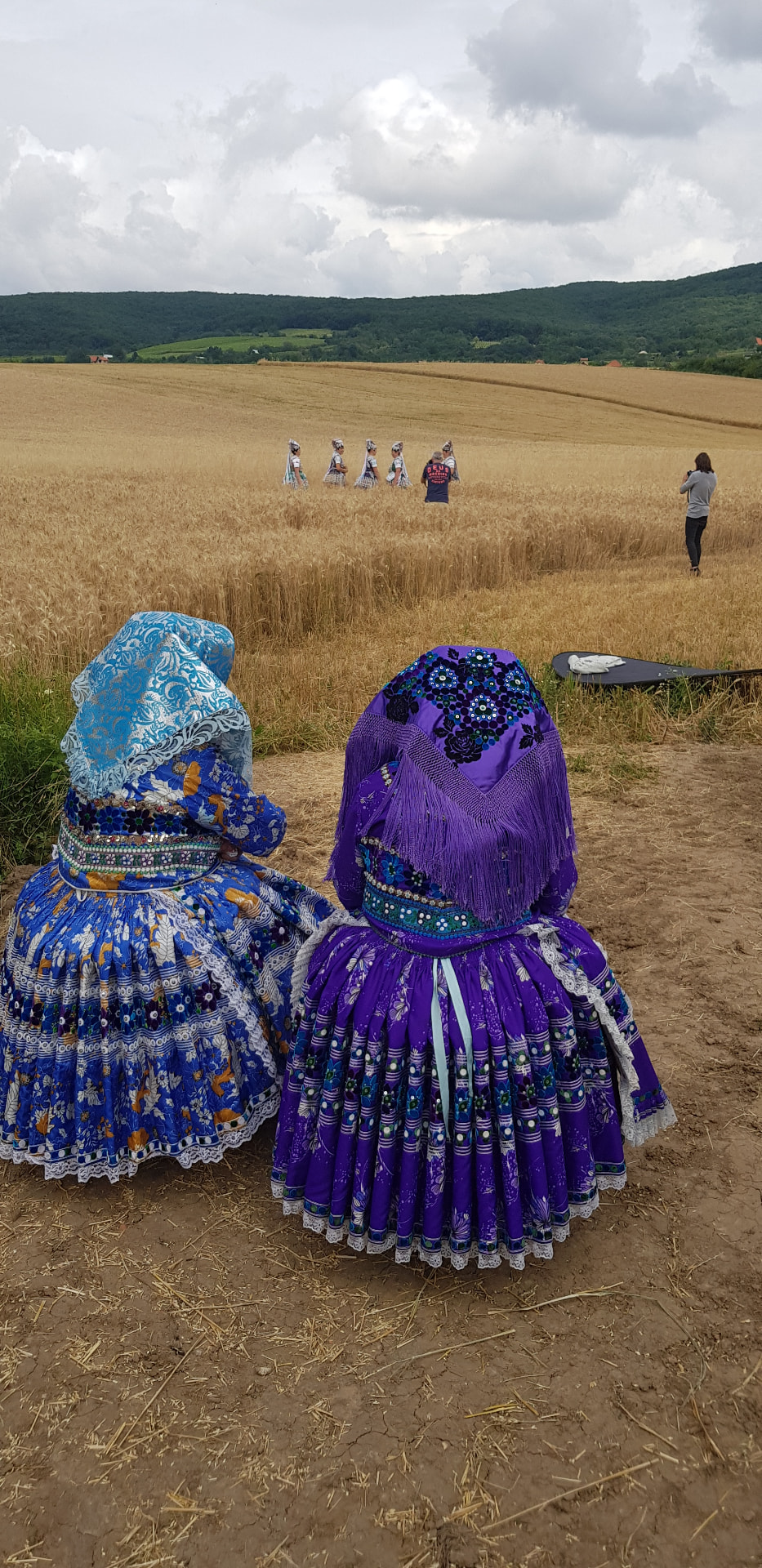
Kroj deserves more than cameras, pathos and quick judgments about what is "authentic." The Slovak Day of Kroj may come from a meaningful idea: to make traditional dress visible, to celebrate regional diversity and to remind people that folk clothing is not only something preserved in museums. But the way kroj is often presented can turn traditional dress into a political, media-friendly and poorly interpreted symbol.
Traditional Slovak folk dress — kroj — has a remarkable ability to awaken emotions.
The moment it appears in a town square, on television, at a political event or in an advertisement, the conversation is no longer only about embroidery, lace, caps or beautifully decorated shirts. Suddenly, people begin to speak about nationhood, roots, pride, kitsch, cultural appropriation, and sometimes even about who has or does not have the "right" to wear kroj, what it should look like and who is allowed to interpret it publicly.
This is why kroj can so easily become surrounded by what we might, with a bit of irony, call a small national hysteria.
Not because the garment itself is the problem. Rather, because we often project too much onto it: ideas of pure tradition, proper patriotism, "ours" and "theirs," or a past that sometimes seems simpler and more beautiful than it really was.
Kroj is not a national uniform, even though it is often presented that way
In the past, traditional folk dress was not only an aesthetic or representative part of everyday and festive life. It was practical clothing. It protected the body, reflected available materials and responded to work, climate, social status and life situations.
At the same time, it carried many layers of information: region, village, age, marital status, religious background and the occasion for which it was worn. Work clothing was different from festive clothing. Festive clothing was different from ceremonial clothing.
That is why kroj is more like a language than a uniform.
It is not one general "Slovak costume" that can be worn as a universal national symbol without context. Slovakia has always been a diverse mosaic of regions and local traditions. This diversity appears in kroje through cut, color, embroidery, lace, the way a scarf is tied, the shape of a cap or the use of particular decorative details.
Kroj does not simply say: "I am Slovak."
It often says something much more precise: where I come from, who I belong to and what story I carry with me.
Why kroj creates such strong reactions
The emotional tension around kroj does not come from fabric, embroidery or ribbons. It comes from the way we handle them today.
When tradition is used as a backdrop without understanding, it becomes an empty symbol.
When kroj appears in public space as a political prop, part of society immediately becomes alert: is this respect, or is it marketing?
And when kroj is turned into a required sign of the "right" relationship to one's country, tradition becomes a loyalty test. This is exactly what creates tension, rejection and public arguments about pride. On social media, kroj can then become an excuse for insults, ridicule or attacks on people who are considered not "authentic enough."
But the opposite reaction can be just as unfortunate.
Not every expression of folkloric pride deserves to be mocked. Not every person wearing kroj is performing an empty spectacle. For many people, kroj represents family memory, the work of grandmothers, local pride, a village, a feast day, songs and people who are no longer with us.
There is a difference between sincere respect and cheap folklorism.
And in loud public debates, that difference is often lost.
Kroj abroad: memory, not a museum mistake
Kroj among Slovaks abroad and descendants of Slovak emigrants deserves special sensitivity.
For the second, third or later generations living outside Slovakia, kroj may not always be an exact reconstruction of regional dress. Very often, it is something else: a family relic, a bridge to a language that may be fading, or a connection to a village known only from grandparents' stories.
Sometimes it is made of whatever survived.
A piece of fabric kept in a chest. Embroidery from a grandmother. A repaired sleeve. A new ribbon sewn from memory. Or a garment assembled from whatever could be found in the country that Slovak descendants now call home.
It may not be a complete kroj in the textbook sense.
But it can still be a powerful expression of preserved family and community memory.
That is why we should be careful when we call such clothing "wrong."
Yes, an ethnologist can identify region, period, material, cut and the authenticity of individual parts. But in the diaspora, kroj often fulfills another function as well. It is not only evidence of clothing history. It is also evidence of memory.
When someone in Canada, the United States, Serbia, Argentina, Romania or anywhere else takes out a kroj that belonged to a grandmother, they may not be claiming to present a perfect regional reconstruction.
They may simply be saying:
This is a piece of our story that we did not want to lose.
Incomplete does not automatically mean wrong
This brings us to an important question: how do we actually know that what we now consider correct, complete and "authentic" always looked exactly that way?
Kroj was never a fixed pattern carved into stone.
It changed according to historical period, access to fabrics, lace, dyes and decorations, the wealth of a family, local customs, contact with towns, the church calendar and fashion of the time.
What we now imagine as the "classic" form of a kroj may actually be a snapshot of one particular moment — not an eternal norm.
One woman may have owned a festive apron made of more expensive fabric. Another may have had a simpler version. One family could afford richer embroidery; another could not. In some places, older garments were worn longer. Elsewhere, they were replaced by urban fashion sooner.
Sometimes kroj was adapted for the stage. Sometimes for photography. Sometimes for a folklore ensemble or a school performance.
So when we see a kroj today without one part, with a different ribbon, with simpler embroidery or with a combination of elements, it does not automatically mean disrespect.
It may mean limited access. It may mean family memory. It may mean regional change. It may simply mean life.
Of course, this does not mean that knowledge does not matter. On the contrary: the more we know about kroj, the more sensitively we can approach it.
But there is a difference between professionally naming an inaccuracy and publicly shaming someone who has put on the last tangible trace of their ancestors.
Kroj should not be a weapon against people who are trying to remember.
It should be an invitation to ask, learn and add context.
Banská Bystrica as a media stage for tradition
The Slovak Day of Kroj in Banská Bystrica is built on an idea that is not wrong in itself.
It makes sense to make traditional folk dress visible, to show its regional diversity and to remind people that kroj is not merely a museum object.
The problem begins when this topic becomes a media attraction and a politically useful symbol. A garment that deserves calm, knowledgeable and sensitive interpretation suddenly becomes a public event on which almost everyone feels invited to comment.
The biggest problem is not necessarily the event itself, but the way it is presented.
Kroj is often turned into an effective image for the media: a colorful parade, emotional language, big words about nation and tradition, quick television segments and simplified slogans.
A garment that is actually the result of complex historical development, regional differences, social layers, material availability and ceremonial contexts is reduced to a beautiful backdrop.
And a backdrop does not need explanation.
It only needs to look good.
When authenticity is mistaken for expertise
In public debate, the main voices are often not ethnologists, clothing historians, museum professionals or people who systematically research traditional dress culture.
Instead, media attention often goes to so-called "authentic" voices: amateur folklorists, collectors, members of folklore ensembles, enthusiasts and event organizers.
Their experience can be valuable. But experience is not automatically expertise.
Wearing kroj, collecting its parts or performing in a folklore ensemble does not automatically mean understanding the history of clothing, regional variants, social meanings or the methods needed to interpret them.
This is where a dangerous shift happens: media often prefer a confident, visual and easily quotable voice over a knowledgeable one.
In such an atmosphere, an organizer of a folklore event may publicly assume the role of commentator and authority on traditional dress, even without deeper professional background.
The point is not to discredit individuals personally.
The point is to name a broader phenomenon: popularity, media presence and organizational visibility can begin to replace knowledge.
The result is a strange situation.
Kroj is talked about a lot, but often imprecisely.
Claims are made about what is "true," "ours," "original" or "correct," without explaining the period, region or social environment on which these claims are based.
Authenticity becomes an impression.
And that impression is then presented as fact.
When political pathos is added to this, a professional topic becomes a cultural battle — and the one who loses most is kroj itself.
What we could do more thoughtfully
Perhaps we need less festival-like certainty and more humility toward the topic.
Less grand language about tradition and more space for people who can describe it in context: experts on folk dress, ethnologists, curators, restorers and regional specialists who can distinguish between stage costume, family heirloom, reconstruction and historical clothing.
Not in order to silence enthusiasts.
But so that enthusiasm does not replace knowledge.
If we want to protect kroj, it is not enough to display it ceremonially in a parade and surround it with cameras.
We need to speak about its origin. We need to name the region, period and function. We need to admit inaccuracies. We need to distinguish between folkloric stylization and historical reality.
And above all, we should not claim expertise simply because we stand close to tradition.
Kroj does not need media hysteria or self-appointed interpreters.
It needs respect, precision and people who understand where enthusiasm ends and knowledge begins.
Conclusion: tradition without clenched fists
The Slovak Day of Kroj in Banská Bystrica does not have to be a problem simply because it wants to show kroj.
It becomes a problem when its presentation turns traditional dress into a political and media spectacle, where expertise disappears under layers of pose, pathos and confident commentary.
The idea may be good.
But if it truly wants to serve tradition, it should not cover it with noise.
Kroj deserves more than a stage.
It deserves understanding.