Story
How Napoleon Sweetened Europe: The Story of Sugar Beet and the Birth of Our Most Common Sweetener
Today we take white sugar entirely for granted. We find it in the kitchen jar, in our morning tea, in cakes and in countless industrially produced foods. But it was not always so. For long centuries, sugar was an immensely rare luxury that an ordinary person could not afford.
As the British writer and historian Henry Hobhouse points out in his famous book Seeds of Change (Šesť rastlín, ktoré zmenili svet), plants and the human desire for them have shaped history more profoundly than many wars or revolutions. For centuries, cane sugar (Saccharum officinarum) was the primary — and practically the only — source of this sweetener in the world. In medieval Europe it was imported at great expense from the Near East, sold in apothecaries by weight as a precious medicine, and served as a prestigious symbol of the wealth of the nobility, who flaunted it at lavish banquets.
Everything changed with the discovery of America and the rise of colonialism. The European powers realised that the Caribbean climate was a paradise for sugar cane. Yet the sweet passion of Europe's elites gave rise to one of the darkest chapters of humanity. As Henry Hobhouse analyses in detail, the insatiable demand for cane sugar became the main engine of the transatlantic slave trade. Millions of Africans were forcibly abducted to plantations in the New World, where they laboured in inhuman conditions. Between 1690 and 1790, Europe imported roughly 12 million tonnes of sugar — a volume which, measured in human suffering and plantation mortality, cost the lives of approximately the same number of enslaved Africans. Sugar thus became literally a "dark luxury".
The astronomical prices of cane sugar, and the moral and economic limits of the colonial trade, eventually forced Europe to seek its own, local alternative. And it came from an unexpected direction — from a humble, pale root vegetable and the military ambitions of a French emperor.
A breakthrough discovery in the shadow of cane
The story of beet sugar began in the mid-18th century. The breakthrough came in 1747, when the Berlin chemist and natural scientist Andreas Sigismund Marggraf discovered that white fodder beet conceals exactly the same sucrose as sugar cane. Marggraf's pupil Franz Carl Achard later, after years of breeding, developed the first true sugar beet from the so-called "Silesian white beet" and built the world's very first sugar factory in Silesia.
Although the discovery was revolutionary, Europe's monarchs and merchants initially ignored it. Imports of cane sugar from the colonies were well established, and no one had the appetite to invest in the risky cultivation of a new crop. For sugar beet to become an industrial giant, a geopolitical earthquake was needed.
1806: Napoleon closes the seas
That earthquake was the Continental Blockade, declared by Napoleon Bonaparte in 1806. Its aim was to destroy Great Britain economically: European ports received a strict ban on admitting British ships and British colonial goods.
Retaliation was not long in coming. The British Royal Navy blockaded the European coast, completely cutting the continent off from imports of Caribbean cane sugar. Its prices soared to astronomical heights and Europe found itself in a deep "sweet crisis".
Napoleon realised that if he wanted to maintain economic stability, he had to find a domestic alternative. He recalled the neglected discoveries of Marggraf and Achard. By imperial decree in 1811, he ordered the mass cultivation of sugar beet on thousands of hectares and financially supported the founding of new sugar factories and schools for sugar-makers. Thanks to this state intervention, sugar beet enjoyed an unprecedented boom in Europe. When Napoleon fell in 1814 and the blockade ended, the beet sugar industry was already so developed and technologically mature that it could successfully compete with cheap cane imports.
How Slovakia became a sugar-making power
Slovakia reacted to this new wave remarkably quickly and became one of the most important centres of sugar-making in the whole of the Kingdom of Hungary. The very first beet sugar on our territory was produced in 1801 by the pharmacist Samuel Johann Gertinger in Prešov.
The true industrial boom, however, came somewhat later. In 1830 the progressive farmer Matej Lačný founded the first Slovak sugar factories in Veľké Úľany and Vojnice. Our fertile lowlands in southern and western Slovakia offered ideal soil and climatic conditions for sugar beet. Production grew at such a pace that Slovak sugar factories were later able to produce up to 70 per cent of the entire sugar output of the then Kingdom of Hungary. Sugar was not sold then in tidy one-kilogram bags, but was moulded into large cones — so-called "sugar loaves" (klobúky) — weighing between 1.2 and 1.8 kilograms.
This enormous industrial development had a fundamental impact on the everyday lives of farmers. Sugar beet became an important cash crop bringing a stable income, and work in the sugar factories (the so-called beet campaigns in autumn and winter) provided vital seasonal employment for thousands of people. Sugar thus gradually displaced the traditional sweetener — honey. With the mass availability of cheap beet sugar in the second half of the 20th century, the character of the population's diet changed markedly, from an original sour-and-salty profile to one rich in sweet pastries and confectionery.
Why do we still sweeten with beet?
You may ask why, even today — in an age of free trade, when we can import anything from the other side of the world — beet sugar still dominates in Europe and in Slovakia. There are three reasons:
- Agronomic tradition and climate: Our soils and temperate zone are ideal for beet. Farmers have centuries-proven practices, modern machinery and high yields.
- Economic self-sufficiency: Producing our own sugar protects the European market from price fluctuations on world exchanges. Growing and processing beet also employs thousands of people in agriculture and the processing industry.
- The ecological aspect: Importing cane sugar by ship across half the globe leaves an enormous carbon footprint. Local beet sugar is far gentler from an environmental point of view.
From industrial sugar to folk traditions
Sugar beet was not only a raw material for factories. The Slovak countryside quickly found its own, immensely creative relationship to it. In times of poverty and war, when refined white sugar was expensive, people boiled their own sirob (beet syrup) on their stoves. According to a research report, the beet was cleaned, chopped and boiled, and the sweet juice obtained was slowly evaporated until it caramelised into a thick black syrup similar to honey. This sirob was used to sweeten porridges, to drizzle over baked leavened buns called peciválky, or to spread on potato flatbreads baked dry directly on the cast-iron plates of the stove.
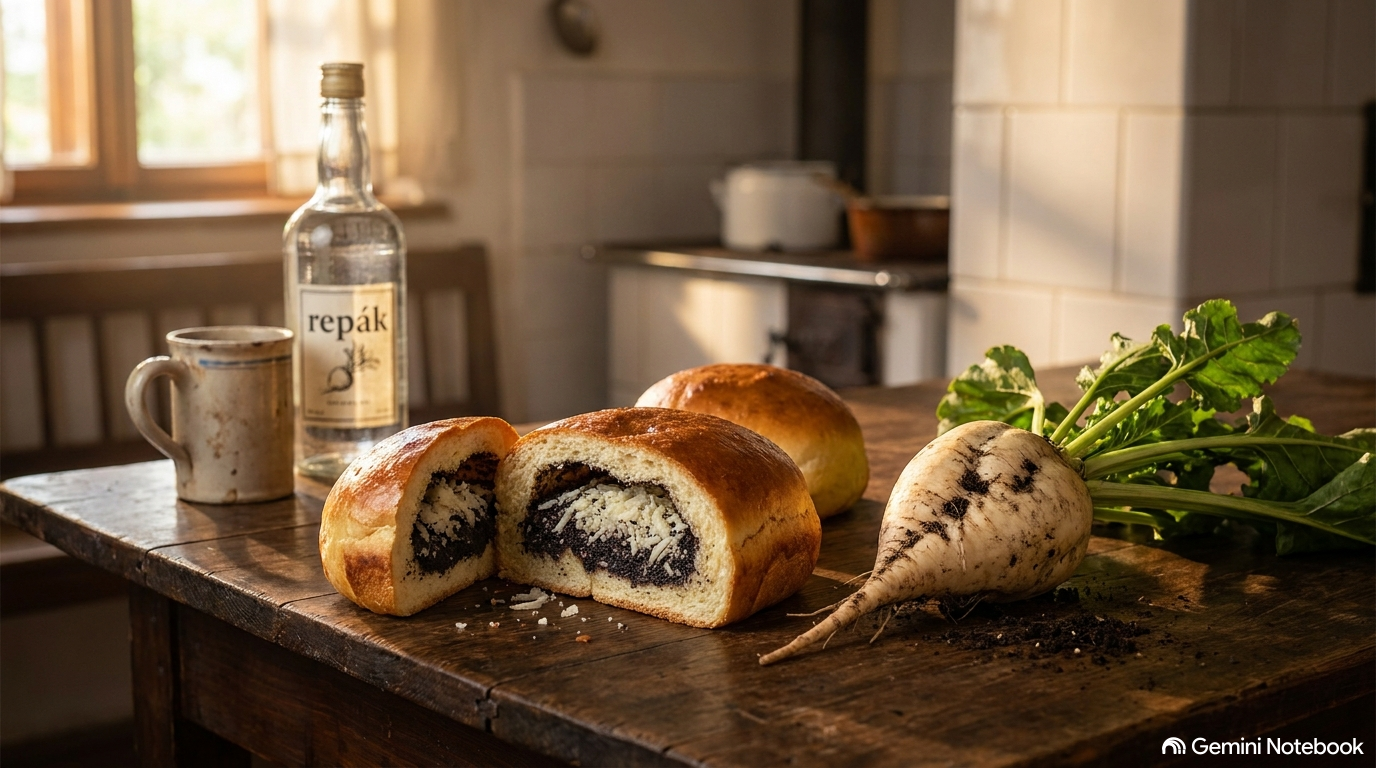
Traditional recipes have survived from this heritage to this day. After the autumn beet harvest, people traditionally baked řepánky (beet pastries) — leavened buns filled with a unique filling of ground poppy seeds and grated stewed sugar beet. The beet played a double role in the filling: it sweetened it naturally and at the same time gave it incredible juiciness, so the buns stayed soft even after several days.
And we must not forget the legendary repák — a spirit distilled from sugar beet juice, a typical speciality of the scattered hill-farm settlements (kopanice) of the White Carpathians and the Považie region. Although homemade repák often had an earthy aftertaste due to insufficient purification, in folk culture it was considered a medicine and an inseparable part of pig-slaughter feasts (zabíjačky). It was believed that, thanks to its high content of beneficial betaine, it protected the liver and aided the digestion of exceptionally heavy and fatty dishes — which gave rise to the well-known saying: "After a repák, one could digest even nails."
Napoleon's sweet legacy
Although Napoleon Bonaparte entered history primarily as a conqueror, military commander and creator of a modern legal code, his most lasting — and sweetest — contribution to our everyday lives is something far more prosaic. Without his uncompromising power struggle with Great Britain and the subsequent decree of 1811, we in Europe and Slovakia would very likely still have considered sweetening an unattainable luxury bound up with colonial exploitation for a long time to come.
Thanks to his strategic pressure for the development of the beet industry, the white sugar beet was transformed from a neglected fodder crop into the queen of European fields. This step laid the foundations of modern food self-sufficiency and built an industry from which we indirectly benefit to this day. Every time we sweeten our morning coffee today, bite into a traditional poppy seed and beet řepánok pastry, or raise a glass of the cult Považie repák with friends, we unknowingly pay tribute to the emperor who, in his effort to win a world war, forever redefined European palates and brought sweetness into ordinary households. Our sweet reality today is thus, in many ways, his least expected — yet most widespread — monument.